




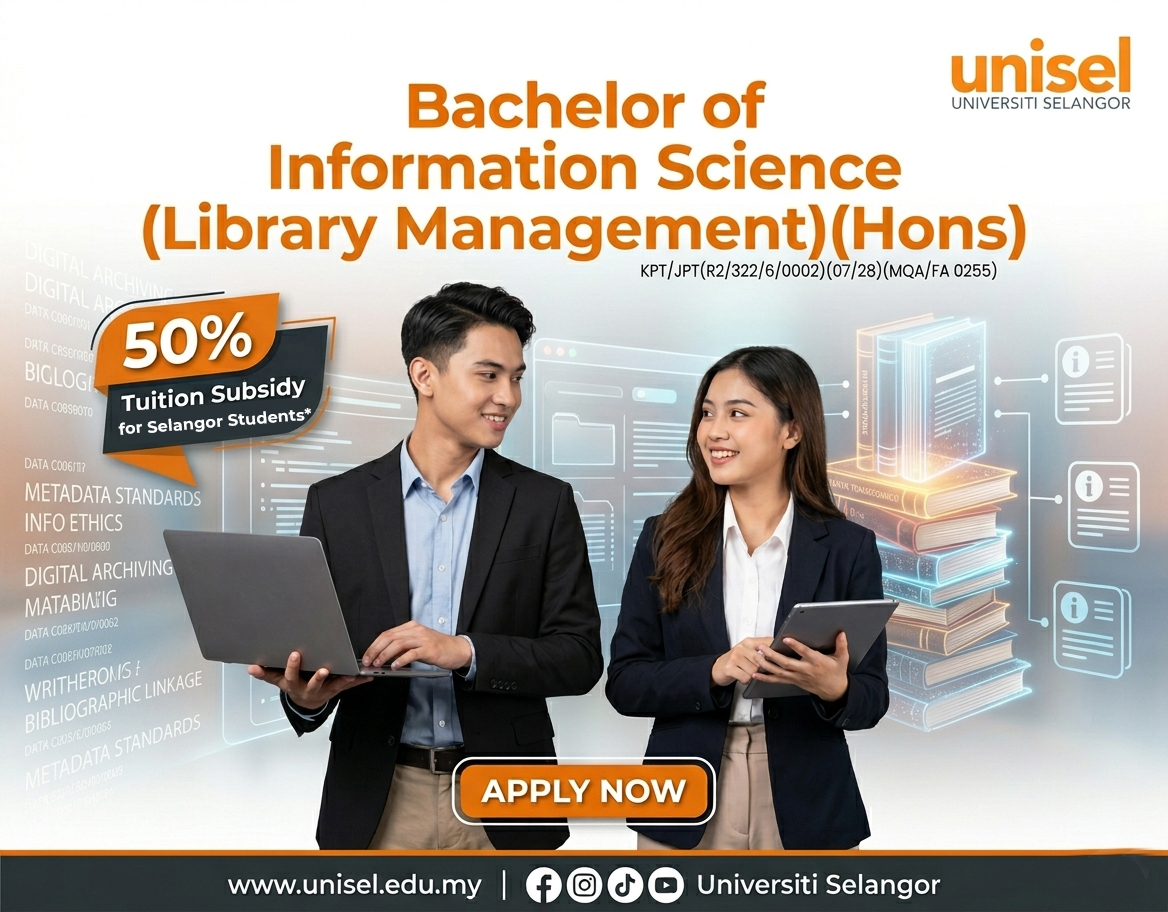
BACHELOR OF INFORMATION SCIENCE (LIBRARY MANAGEMENT)(HONS)
KPT/JPT(R2/322/6/0002)(07/28)(MQA/FA 0255)
Programme Description
The Bachelor of Information Science(Library Management)(Hons) Program at Universiti Selangor (UNISEL) is meticulously designed to provide students with comprehensive knowledge and advanced skills required to excel as professionals in managing modern libraries and information centres. This program bridges the gap between traditional library sciences and cutting-edge information technology, ensuring graduates are well-prepared to meet the evolving demands of the digital age. With a strong focus on industry relevance, the curriculum is tailored to align with current trends and needs, producing competent professionals ready to thrive in various roles within the library and information services sector.
PROGRAMME HIGHLIGHT
COMPREHENSIVE CURRICULUM
Covers a wide range of topics including library automation, digital resource management, cataloging and classification, research methodology, and information retrieval systems to develop well-rounded library professionals. Our curriculum emphasizes on:
- Library Automation and Digital Resource Management
- Cataloging and Classification
- Research Methodology in Library Science
- Information Retrieval Systems and Database Management
- Knowledge Organization and Information Services
- Alignment with Industry Standards
- Collaboration with Industry Experts
- Real-World Case Studies and Projects
- Internship and Practical Training Opportunities
- Preparation for Emerging Trends
- Library Automation and Digital Resource Management
- Cataloging and Classification
- Research Methodology in Library Science
- Information Retrieval Systems and Database Management
- Knowledge Organization and Information Services
- Academic Advising and Mentorship
- State-of-the-Art Learning Facilities
- Professional Development Workshops
- Student Counseling and Well-Being Services
- Financial Assistance and Scholarships
ENTRY REQUIREMENTS
- Passed in STPM or its equivalent, with a minimum of Grade C (GP 2.00) in any two subjects and a pass in Mathematics or Additional Mathematics at SPM level or its equivalent; OR
- Passed in STAM with a minimum grade of Jayyid and a pass in Mathematics or Additional Mathematics at SPM level; OR
- A Diploma or its equivalent, with a minimum CGPA of 2.00 and a pass in Mathematics or Additional Mathematics at SPM level or its equivalent; OR
- Matriculation / Foundation or equivalent, with a CGPA of 2.00 and a pass in Mathematics at SPM Level or equivalent or its equivalent. OR
- Passed in UEC with minimum Grade B in 5 subjects and pass in English subject.
TUITION FEES
- Local tuition fee: RM24,270
- International tuition fee: #
STUDENT OUTCOMES
Graduates of the Bachelor of Information Science (Library Management)(Hons). at Universiti Selangor (UNISEL) will be equipped with the knowledge, skills, and attributes necessary to thrive in the library and information services field. Upon completion of the program, students will be able to:
- Deliver User-Centered Library Services.
- Exhibit Strong Analytical and Research Skills.
- Utilize Modern Technologies in Library Operations.
- Demonstrate Leadership and Professionalism.
- Demonstrate Expertise in Library Science and Information Management.
CAREER OPPORTUNITIES
Graduates of the Bachelor of Information Science (Library Management)(Hons) program at Universiti Selangor (UNISEL) are well-equipped to pursue diverse and rewarding careers in the library and information services sector. The program prepares students for roles in various industries, including academic, public, corporate, and government institutions. Upon graduation, students can explore the following career opportunities:
Librarian
Serving in public, academic, school, or special libraries to manage collections, assist users, and provide access to diverse information resources.
Digital Librarian or Resource Manager
Overseeing digital collections, managing online databases, and ensuring seamless access to electronic resources.
Archivist or Records Manager
Preserving historical records and managing organizational archives in museums, government agencies, or corporate environments.
Knowledge Manager
Facilitating the creation, organization, and sharing of knowledge assets within businesses, nonprofits, or educational institutions.
Information Specialist
Providing expert research and information retrieval services in specialized fields such as healthcare, legal services, and corporate sectors.
Library Technology Specialist
Implementing and managing library automation systems, digital platforms, and innovative technologies to improve user services.
Corporate Librarian
Delivering tailored research and information services in corporate settings to support business strategies and decision-making.
Community Engagement Coordinator
Developing outreach programs and initiatives to connect communities with valuable library resources and services.
Other Recommended Programmes





Programme Info
- DURATION: 2 ½ Years
- TUITION FEES:
Local: RM24,270
International: RM# - MQA:
KPT/JPT(R2/322/6/0002)(07/28)(MQA/FA 0255)