







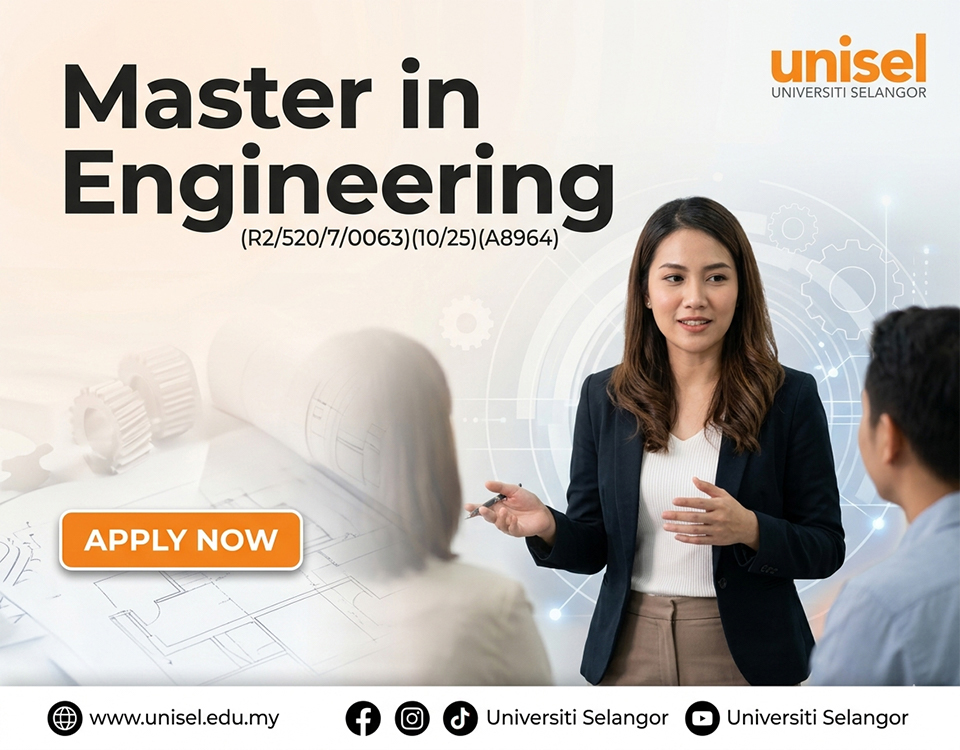
MASTER IN ENGINEERING
(R2/520/7/0063)(10/25)(A8964)
Programme Description
The Master in Engineering programmes focus on applied research in fields that have the potential to contribute significantly to the development of the Malaysian economy. The major fields of study include Mechanical, Civil, Electronic, Electrical, and Mechatronic Engineering, with specializations in Structural Health Monitoring, Automotive Engineering, Control Engineering, Computational Mechanics, Highway and Transportation Engineering, Nanomaterials Engineering, Power Electrical Engineering, and Energy Generation and Management. These research projects are designed to meet industrial needs and are conducted in collaboration with industry partners, who often co-supervise the projects externally.
PROGRAMME HIGHLIGHT
Program Educational Objectives
- To produce graduates that able to apply knowledge in a specific discipline in engineering and technology.
- To produce competent graduate in carrying out research with utilization of analytical and problem-solving skills in order to evaluate and make decisions critically and creatively based on research evidence and/or experience.
- To produce graduate that possess excellent generic skills such as attitudes, ethics, sense of professionalism and leadership skills for societal advancement within the framework of the national vision.
- To produce graduates with enhancement of the quest for knowledge and lifelong learning skills
- Research Proposal Development
-
- Students work closely with their supervisors to identify a research area of interest.
- Development of a detailed research proposal is required, including a literature review, research objectives, problem statement, significance of study, methodology, and expected outcomes.
- Research Methodology Course
-
- This course provides students with the skills and knowledge necessary to perform and present research successfully.
- The course integrates theoretical knowledge with practical applications, ensuring students are well-prepared for each stage of their research journey and beyond.
- Research Execution
-
- Implementation of the research plan under the guidance of supervisors.
- Engagement in experimental work, data collection, and analysis.
- Research Progress Evaluation
-
- Progress is monitored each semester through presentations at the faculty level, and once during the study period by the Center for Graduate Studies (CGS) to ensure students remain on track with their research goals.
- Attendance and Participation in Academic Seminars, Conferences, and Workshops
-
- Attendance and active participation in academic seminars, conferences, and workshops to enhance knowledge and skills in engineering.
- Opportunities to present research findings and gain constructive feedback.
- Thesis Preparation and Submission
-
- Compilation of research findings into a comprehensive thesis.
- Adherence to the university's thesis submission guidelines.
- Thesis Defense (Viva Voce)
-
- Oral defense of the research work before an examination panel.
- Demonstration of in-depth knowledge, analytical thinking, and problem-solving skills.
- Academic Advising: Personalized guidance on course selection, academic progress, and career planning.
- Peer Mentoring: Opportunities to connect with other local and international students who can offer advice and support.
- Conducive Facilities: Access to modern engineering and computer laboratories, libraries, sports centre, cafes, hostels and other facilities.
ENTRY REQUIREMENTS
- A Bachelor’s Degree in Engineering or equivalent with at least a CGPA of 2.75 from an Institution of Higher Learning (IHL) as approved by UNISEL Senate.
- OR A Bachelor’s Degree in Engineering or equivalent with a CGPA of at least 2.50 but less than 2.75 may be accepted to enroll in the program, subject to a detailed internal evaluation by the UNISEL Senate.
- OR A Bachelor’s Degree in Engineering or another equivalent qualification with a CGPA of less than 2.50 may be accepted with a minimum of 5 years working experience in a related field.
TUITION FEES
- Local tuition fee: RM13,200
- International tuition fee: RM19,200
STUDENT OUTCOMES
Upon graduation, our Master in Engineering graduates will be able to:
- Demonstrate mastery of knowledge in a specific discipline in engineering and technology.
- Generates solutions to problems using scientific and critical thinking skills.
- Relate ideas to societal issues in the relevant field.
- Conduct research with minimal supervision and adhere to legal, ethical and professional codes of practice.
- Apply practical skills in the relevant field.
- Demonstrate leadership qualities through communicating and working effectively with peers and stakeholders.
- Manage information for lifelong learning.
- Initiate and lead entrepreneurial ventures and projects.
CAREER OPPORTUNITIES
Graduates with a Master’s in Engineering degree can find employment in both government and private sectors. Typically, graduates are more involved in research, either in industry or the academic sector related to their discipline.
Other Recommended Programmes










Programme Info
- DURATION: 2 - 4 Years
- TUITION FEES:
Local:RM13,200
International: RM19,200 - MQA:
(R2/520/7/0063)(10/25)(A8964)